
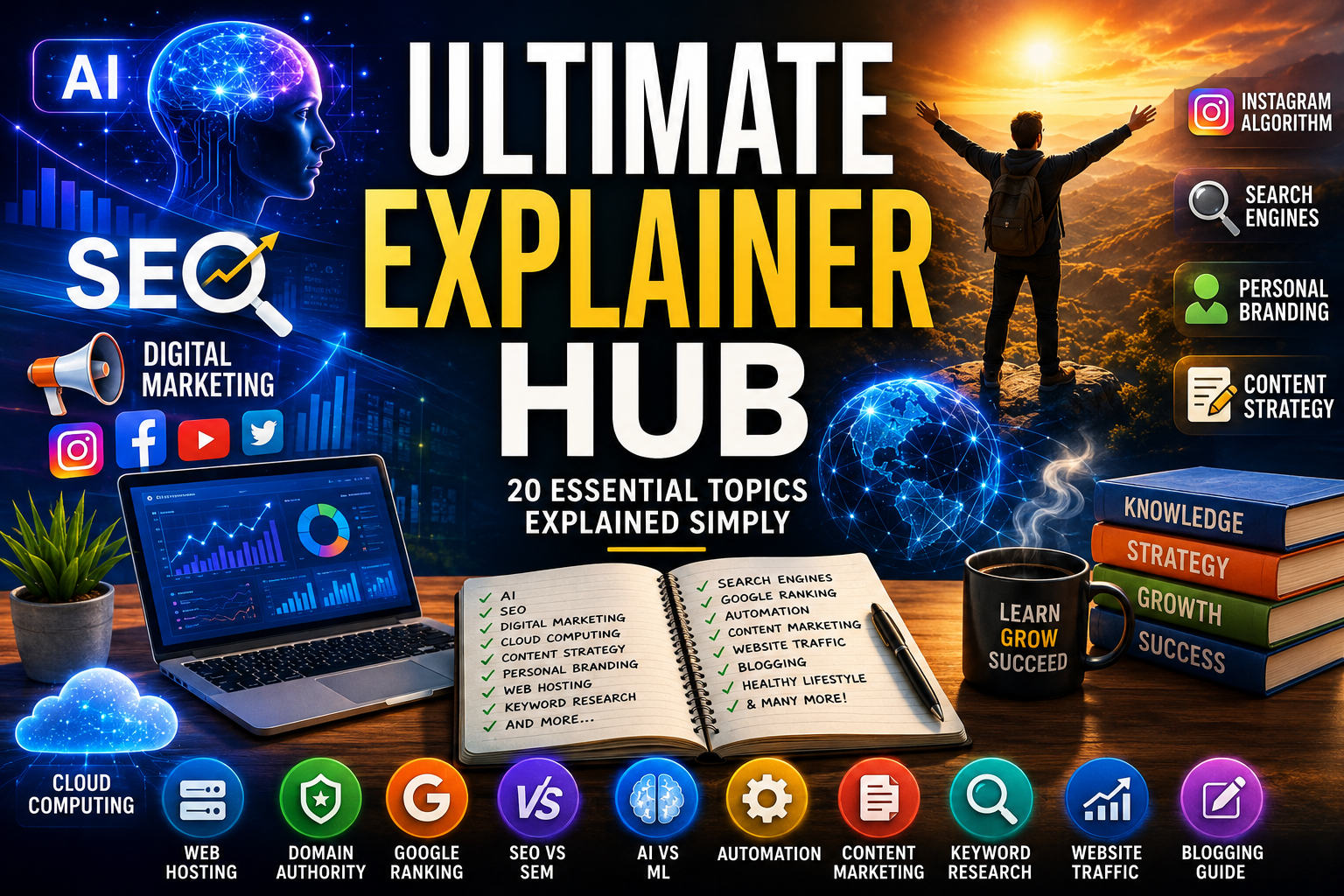
Ultimate Explainer Hub: The digital world is evolving faster than ever before. Every day, people encounter terms such as Artificial Intelligence, SEO, Cloud Computing, Digital Marketing, Content Strategy, Automation, and Personal Branding. While these concepts drive modern business and technology, many beginners find them confusing and difficult to understand.
This Ultimate Explainer Hub serves as a comprehensive resource that explains the most important digital concepts in simple language. Whether you are a student, entrepreneur, content creator, marketer, blogger, or business owner, understanding these topics will help you navigate today’s digital landscape more effectively.
In this guide, we will explore the fundamentals of artificial intelligence, search engine optimization, digital marketing, cloud computing, content marketing, website traffic, blogging, and many other essential topics that shape the internet economy.
What Is Artificial Intelligence (AI)?
Artificial Intelligence, commonly known as AI, refers to computer systems designed to perform tasks that normally require human intelligence. These tasks include learning, problem-solving, decision-making, language understanding, image recognition, and pattern detection.
AI has become one of the most transformative technologies of the modern era. Applications of AI can be found in smartphones, search engines, recommendation systems, virtual assistants, healthcare technologies, autonomous vehicles, and customer service chatbots.
Unlike traditional software that follows predefined rules, AI systems can analyze large amounts of data, identify patterns, and improve performance over time. This ability allows AI to generate human-like responses, predict outcomes, and automate complex processes.
Today, AI is influencing nearly every industry and is expected to play an even larger role in shaping the future of business, education, healthcare, and communication.
What Is SEO?
Search Engine Optimization (SEO) is the process of improving a website’s visibility in search engine results. The goal of SEO is to attract organic traffic by helping web pages rank higher for relevant search queries.
When users search for information on search engines, they typically click on results appearing near the top of the page. SEO helps websites earn these valuable positions by optimizing content, technical performance, and authority signals.
SEO involves several components including keyword optimization, content creation, technical website improvements, internal linking, user experience enhancement, and backlink acquisition.
Businesses invest heavily in SEO because higher rankings often lead to increased traffic, leads, sales, and brand awareness without relying solely on paid advertising.
What Is Digital Marketing?
Digital marketing refers to promoting products, services, or brands using digital channels and internet-based platforms. It encompasses a wide range of strategies designed to reach online audiences and drive business growth.
Common digital marketing channels include:
- Search Engine Optimization (SEO)
- Social Media Marketing
- Email Marketing
- Content Marketing
- Pay-Per-Click Advertising
- Influencer Marketing
- Video Marketing
Digital marketing enables businesses to reach targeted audiences, measure campaign performance, and optimize marketing efforts using real-time data.
As consumer behavior increasingly shifts online, digital marketing has become one of the most important functions within modern organizations.
What Is Cloud Computing?
Cloud computing refers to delivering computing services over the internet instead of relying on local hardware or physical servers.
Cloud services may include:
- Data storage
- Software applications
- Virtual servers
- Database management
- Networking resources
Popular cloud platforms allow individuals and businesses to access powerful computing resources from anywhere with an internet connection.
Cloud computing offers several advantages including scalability, flexibility, cost savings, improved collaboration, and easier maintenance. Many of the digital services people use daily depend on cloud infrastructure to operate efficiently.
What Is a Healthy Lifestyle?
A healthy lifestyle refers to habits and behaviors that support physical, mental, and emotional well-being. While technology continues advancing rapidly, maintaining personal health remains essential for long-term success and happiness.
A healthy lifestyle typically includes:
- Balanced nutrition
- Regular exercise
- Quality sleep
- Stress management
- Adequate hydration
- Positive social relationships
Small daily choices often have a significant impact on overall health. Building sustainable habits is generally more effective than pursuing extreme short-term solutions.
How Does Instagram’s Algorithm Work?
Instagram’s algorithm determines which content users see in their feeds, stories, reels, and explore pages.
The platform evaluates various signals including:
- User engagement
- Content relevance
- Viewing history
- Relationship strength
- Content popularity
When users frequently interact with certain accounts, Instagram is more likely to show them content from those creators.
Reels have become particularly important because Instagram actively promotes engaging short-form video content. Understanding the algorithm helps creators increase visibility, engagement, and audience growth.
How Search Engines Work
Search engines help users find relevant information across billions of web pages.
The process typically involves three main stages:
Crawling
Search engine bots discover web pages by following links across the internet.
Indexing
Discovered content is analyzed and stored within large databases.
Ranking
When a user performs a search, algorithms evaluate indexed pages and rank results based on relevance, authority, quality, and user experience.
Search engines continuously update their algorithms to provide more accurate and useful results.
What Is Personal Branding?
Personal branding is the process of shaping and promoting how others perceive you professionally and personally.
In the digital age, personal branding has become increasingly important for entrepreneurs, creators, freelancers, executives, and job seekers.
A strong personal brand typically includes:
- Consistent messaging
- Professional expertise
- Valuable content creation
- Strong online presence
- Clear positioning
Personal branding helps individuals build trust, authority, and recognition within their industries.
What Is a Content Strategy?
A content strategy is a structured plan for creating, publishing, managing, and distributing content to achieve specific goals.
Effective content strategies align business objectives with audience needs.
A strong content strategy includes:
- Audience research
- Content planning
- Keyword targeting
- Publishing schedules
- Distribution channels
- Performance measurement
Without a strategy, content creation often becomes inconsistent and less effective.
What Is Web Hosting?
Web hosting is a service that stores website files and makes them accessible on the internet.
Every website requires hosting to function online. Hosting providers maintain servers that store website data and deliver it to visitors when requested.
Types of hosting include:
- Shared hosting
- VPS hosting
- Dedicated hosting
- Cloud hosting
Choosing the right hosting solution impacts website speed, security, uptime, and scalability.
What Is Domain Authority?
Domain Authority is a metric used to estimate the relative strength and credibility of a website.
Although not an official search engine ranking factor, domain authority often correlates with a website’s ability to rank for competitive keywords.
Factors influencing authority include:
- Backlink quality
- Content quality
- Website age
- Brand reputation
- User engagement
Websites with stronger authority generally have an easier time achieving high search engine rankings.
How Does Google Ranking Work?
Google uses hundreds of ranking signals to determine which pages should appear for specific search queries.
Some major ranking considerations include:
- Content relevance
- Search intent satisfaction
- Page experience
- Backlink profile
- Mobile friendliness
- Website speed
- Expertise and trustworthiness
Google’s objective is to provide users with the most accurate, useful, and reliable information possible.
Because algorithms constantly evolve, website owners must focus on creating valuable content rather than attempting to manipulate rankings.
Difference Between SEO and SEM
SEO and SEM are closely related but distinct marketing strategies.
SEO
SEO focuses on earning organic traffic through improved search rankings without directly paying for clicks.
Benefits include:
- Long-term traffic growth
- Higher trust
- Sustainable visibility
SEM
Search Engine Marketing typically includes paid advertising campaigns that appear in search engine results.
Benefits include:
- Immediate visibility
- Fast traffic generation
- Precise targeting
Many businesses use both SEO and SEM together for maximum effectiveness.
AI vs Machine Learning
Artificial Intelligence and Machine Learning are often used interchangeably, but they are not identical.
AI is the broader concept of machines performing intelligent tasks.
Machine Learning is a subset of AI that allows systems to learn from data and improve performance without explicit programming.
All machine learning is AI, but not all AI relies on machine learning.
Machine learning powers many modern applications including recommendation systems, fraud detection, predictive analytics, and image recognition.
What Is Automation?
Automation involves using technology to perform tasks with minimal human intervention.
Businesses increasingly automate repetitive processes to improve efficiency, reduce errors, and lower operational costs.
Examples include:
- Email automation
- Manufacturing robots
- Customer service chatbots
- Workflow automation
- Marketing automation
Automation enables organizations to focus human effort on higher-value activities while improving productivity.
What Is Content Marketing?
Content marketing is the practice of creating and distributing valuable content to attract, engage, and retain a target audience.
Unlike traditional advertising, content marketing focuses on providing useful information rather than directly promoting products.
Common content formats include:
- Blog posts
- Videos
- Infographics
- Podcasts
- Guides
- Case studies
Successful content marketing builds trust, authority, and long-term customer relationships.
What Is Keyword Research?
Keyword research is the process of identifying search terms that people use when looking for information online.
Effective keyword research helps businesses understand:
- Audience interests
- Search demand
- Competition levels
- Content opportunities
Keyword research forms the foundation of SEO and content marketing strategies.
Targeting relevant keywords improves visibility and helps attract qualified visitors.
What Is Website Traffic?
Website traffic refers to the number of visitors accessing a website.
Traffic can originate from multiple sources:
- Organic search
- Social media
- Direct visits
- Referral websites
- Paid advertising
- Email marketing
Monitoring traffic helps businesses evaluate marketing performance and identify growth opportunities.
High-quality traffic is generally more valuable than simply increasing visitor numbers.
Beginner Guide to Blogging
Blogging remains one of the most effective methods for sharing knowledge, building authority, and generating website traffic.
Starting a blog typically involves:
- Choosing a niche
- Registering a domain name
- Selecting web hosting
- Creating valuable content
- Optimizing for SEO
- Promoting content
- Building an audience
Successful blogs focus on solving audience problems and providing valuable information consistently.
Over time, blogging can support personal branding, lead generation, business growth, and income opportunities.
Why Understanding These Concepts Matters
The digital economy continues expanding rapidly, creating new opportunities for businesses and individuals alike. Understanding concepts such as AI, SEO, content marketing, automation, cloud computing, and personal branding provides a significant advantage in today’s competitive environment.
These technologies and strategies influence how businesses operate, how consumers discover information, and how professionals build careers. Individuals who understand these concepts are better equipped to adapt to changing market conditions and leverage digital opportunities.
Conclusion
The Ultimate Explainer Hub provides a foundational understanding of the most important concepts shaping the modern digital world. From Artificial Intelligence and Search Engine Optimization to Cloud Computing, Content Marketing, Automation, and Blogging, each topic plays a critical role in today’s online ecosystem.
As technology continues evolving, digital literacy becomes increasingly valuable. Whether you are launching a business, building a personal brand, improving marketing performance, or simply seeking to understand modern technology, mastering these concepts will help you navigate the digital landscape with confidence.
The most successful individuals and organizations are not necessarily those with the most resources, but those who continuously learn, adapt, and apply emerging knowledge effectively. Understanding these digital fundamentals is the first step toward thriving in the connected world of today and tomorrow.