

Imagine being handed a beautifully drafted guarantee for your fundamental rights—freedom of speech, equality before the law, protection of life and personal liberty. Now imagine that when someone violates those rights, you have absolutely no way to enforce them. The guarantee becomes a meaningless piece of paper.
The framers of the Indian Constitution understood this problem perfectly. They knew that declaring fundamental rights in Part III of the Constitution wasn’t enough; citizens needed a powerful, direct mechanism to enforce them.
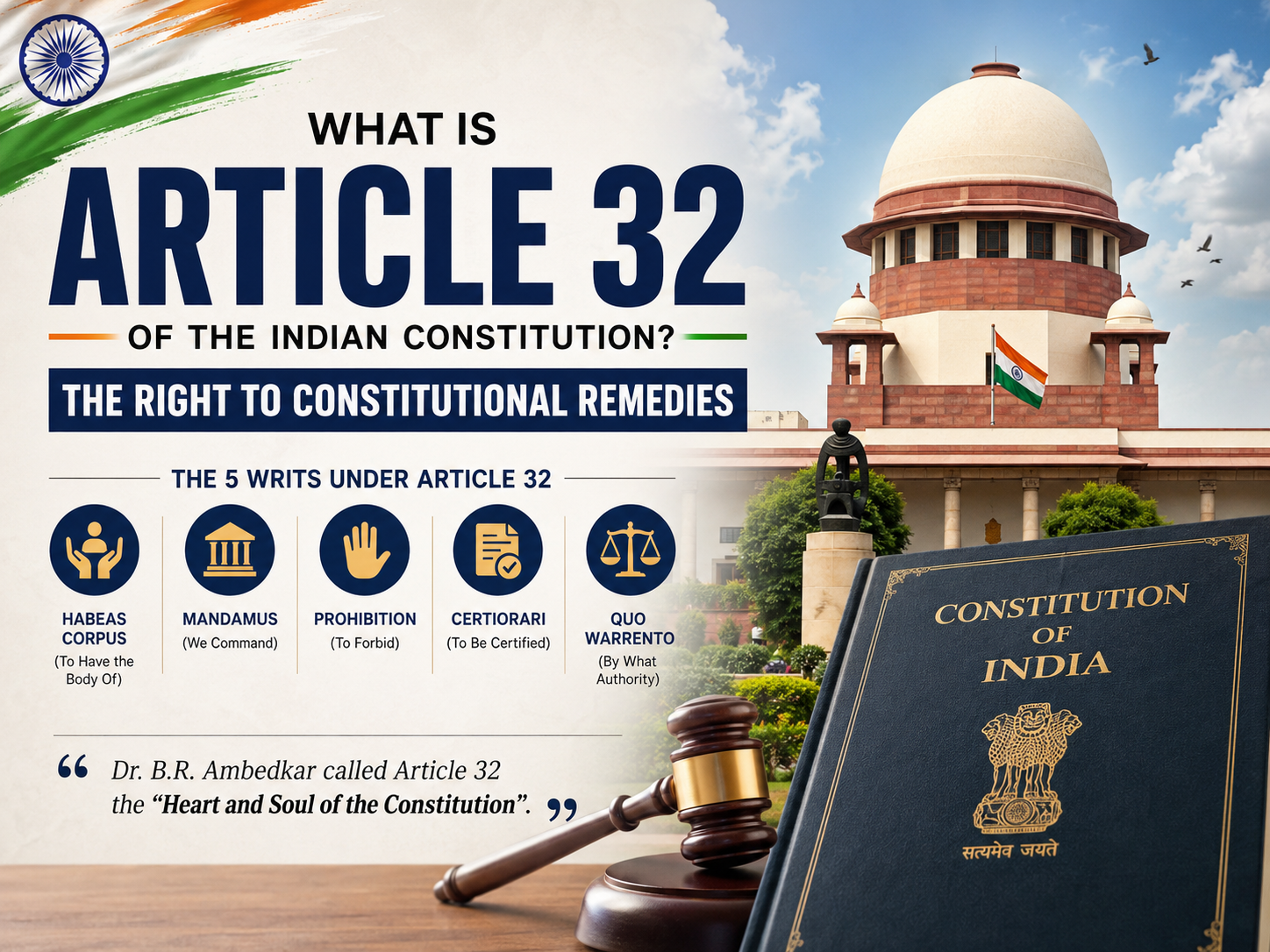
So, what is Article 32 of the Indian Constitution? Simply put, it is the fundamental right that protects all your other fundamental rights. It guarantees every citizen the right to move the Supreme Court of India directly if their fundamental rights are violated.
During the Constituent Assembly debates, Dr. B.R. Ambedkar famously referred to Article 32 as the “heart and soul” of the Constitution. Without it, he argued, the Constitution would be a nullity.
Let’s break down exactly how this right works, the specific legal tools (writs) it provides, and why it remains one of the most powerful legal provisions available to Indian citizens.
The Core Philosophy: Why a Remedy is a Right
Most legal systems require you to climb a hierarchical ladder. If you have a legal dispute, you typically start at a lower district court, appeal to a High Court, and only reach the Supreme Court after years of litigation.
Article 32 disrupts this entirely when it comes to fundamental rights. It allows an aggrieved person to bypass the lower courts and knock directly on the doors of the highest court in the country. By embedding this remedy within Part III of the Constitution, the framers elevated the enforcement mechanism itself to the status of a Fundamental Right. The State cannot suspend this right arbitrarily, ensuring that the Supreme Court remains the ultimate protector and guarantor of civil liberties.
Understanding the Writs: The Five Weapons of Article 32
When you approach the Supreme Court under Article 32, the court exercises its power by issuing directions, orders, or “writs.” A writ is a formal written order issued by a judicial authority directing a person, official, or tribunal to perform or refrain from performing a specific act.
Borrowing from English common law, the Indian Constitution empowers the Supreme Court to issue five specific prerogative writs. Understanding these five tools is crucial to fully grasping what Article 32 of the Indian constitution is and how it functions in the real world.
1. Habeas Corpus: “To Have the Body Of”
Habeas Corpus is perhaps the most famous and frequently invoked writ. The Latin term translates to “you may have the body.”
This writ is a powerful safeguard against illegal detention or arbitrary arrest. If a person is detained by the police or even a private individual without legal justification, their family members, friends, or even strangers can file a Habeas Corpus petition.
When the Supreme Court issues this writ, it commands the detaining authority to physically present the detained person before the court. The court then examines the legality of the detention. If the detention lacks legal backing, the court immediately orders the person’s release.
Real-World Scenario: If local police hold an activist in custody for weeks without presenting them before a magistrate (which is a constitutional requirement within 24 hours), a writ of Habeas Corpus forces the police to produce the individual and justify the arrest.
2. Mandamus: “We Command”
Mandamus translates to “we command.” The Supreme Court issues this writ to a public official, government, or public body, ordering them to perform a legal duty that they have refused to perform.
This writ acts as a check on executive inaction. However, you cannot issue a Mandamus against a private individual or a private company. It is strictly reserved for public authorities who are failing to execute their statutory or constitutional obligations. Furthermore, the duty in question must be mandatory, not discretionary.
Real-World Scenario: If a qualified student is illegally denied admission to a government university despite meeting all criteria and following all procedures, they can seek a writ of Mandamus to compel the university to grant the admission.
3. Prohibition: “To Forbid”
While Mandamus commands activity, Prohibition commands inactivity. Sometimes colloquially called a “stay order,” a writ of Prohibition is issued by the Supreme Court to a lower court or a quasi-judicial body (like a tribunal).
Its purpose is to prevent a lower court from exceeding its jurisdiction or acting contrary to the rules of natural justice. It is a preventive writ. You file it when a lower court is currently hearing a case it has no legal authority to judge.
Real-World Scenario: If a consumer disputes tribunal suddenly starts trying a criminal murder case (which is vastly outside its legal jurisdiction), the Supreme Court can issue a writ of Prohibition to halt the proceedings immediately.
4. Certiorari: “To Be Certified”
Certiorari is a cousin to Prohibition, but it operates after the fact. While Prohibition is preventive (stopping a trial in progress), Certiorari is curative (quashing a decision already made).
The Supreme Court issues this writ to a lower court or tribunal to transfer a pending matter to itself or to entirely quash an order passed by the lower authority. This happens when the lower court has acted without jurisdiction, exceeded its jurisdiction, or committed a glaring error of law on the face of the record.
Real-World Scenario: If a lower court passes a judgment based on a law that was repealed five years ago, the aggrieved party can seek a writ of Certiorari to have that legally flawed judgment completely wiped from the record.
5. Quo Warranto: “By What Authority”
The final writ, Quo Warranto, asks a simple but devastating question: “By what authority or warrant do you hold this office?”
This writ prevents illegal usurpation of public offices. If a person is occupying a substantive public office without possessing the legal qualifications for it, any citizen can challenge their appointment. If the court finds that the person has no legal right to the office, it will oust them immediately.
Real-World Scenario: If a state appoints a Chief Secretary who does not meet the mandatory constitutional or statutory age and experience requirements, a writ of Quo Warranto can be filed to remove them from that position.
Article 32 vs. Article 226: Understanding the Difference
A common point of confusion when asking what is Article 32 of the Indian constitution is how it relates to the High Courts. While Article 32 gives writ jurisdiction to the Supreme Court, Article 226 gives similar writ jurisdiction to the High Courts of various states.
However, they are not identical. In fact, in one specific way, the High Courts have more power than the Supreme Court. Let’s compare them:
| Feature | Article 32 (Supreme Court) | Article 226 (High Courts) |
| Scope of Power | Narrower. Can only be invoked for the violation of Fundamental Rights (Part III). | Wider. Can be invoked for the violation of Fundamental Rights AND any other legal rights. |
| Status of Right | Article 32 is itself a Fundamental Right. The Supreme Court generally cannot refuse to exercise its writ jurisdiction. | Article 226 is a constitutional right, not a fundamental right. It is a discretionary power of the High Court. |
| Territorial Reach | The Supreme Court can issue writs against any authority throughout the territory of India. | A High Court can only issue writs within its own territorial jurisdiction (its specific state). |
Because Article 226 is broader, the Supreme Court often advises petitioners to approach their local High Court first if the matter can be resolved there, reserving Article 32 for severe, national, or direct violations of Part III rights.
The Evolution: Locus Standi and Public Interest Litigation (PIL)
For decades after the Constitution was adopted, a strict legal principle governed Article 32: Locus Standi. This meant that only the specific person whose rights were violated could approach the court.
But what if the victim is a bonded laborer who cannot afford a lawyer? What if the victims are illiterate undertrial prisoners who don’t even know their rights?
In the late 1970s and 1980s, visionary judges like Justice P.N. Bhagwati and Justice V.R. Krishna Iyer revolutionized how we understand what Article 32 of the Indian Constitution is by relaxing the rule of locus standi. They birthed the concept of Public Interest Litigation (PIL).
Under PIL jurisprudence, any public-spirited individual or organization can file an Article 32 petition on behalf of marginalized, disadvantaged, or impoverished groups who cannot approach the court themselves. The court even began accepting letters written on plain postcards as formal writ petitions. This transformation turned Article 32 from a tool for the elite into a weapon for the masses, leading to landmark interventions in environmental protection, prison reforms, and labor rights.
Landmark Judgments Relying on Article 32
To truly grasp the impact of this constitutional provision, we must look at how it has shaped modern Indian jurisprudence. Several cornerstone cases hinge entirely on the invocation of this article:
- Bandhua Mukti Morcha v. Union of India (1984): An NGO wrote a letter to the Supreme Court detailing the horrific conditions of bonded laborers in stone quarries. Treating the letter as an Article 32 petition, the Court issued sweeping directives to free and rehabilitate the laborers, cementing the power of PILs.
- K.S. Puttaswamy v. Union of India (2017): The historic judgment that recognized the Right to Privacy as a fundamental right under Article 21 was initiated via writ petitions filed under Article 32, challenging the government’s Aadhaar scheme.
- MC Mehta v. Union of India: Across several decades, environmentalist M.C. Mehta has used Article 32 to force the Supreme Court to intervene in severe environmental crises, from protecting the Taj Mahal from industrial pollution to cleaning up the Ganga river.
Limitations: When Can’t You Invoke Article 32?
While it is a formidable tool, Article 32 is not a magic wand for every legal grievance. There are specific limitations:
- No Fundamental Right Violation: If your grievance involves a breach of a simple contract, a property dispute between neighbors, or a violation of a regular statute (but not a fundamental right), the Supreme Court will dismiss your Article 32 petition. You must use regular civil or criminal courts.
- During Emergencies: Under Article 359 of the Constitution, the President of India can suspend the right to move any court for the enforcement of fundamental rights during a declared National Emergency. (However, following the 44th Amendment, the right to move the court for Articles 20 and 21—protection in respect of conviction for offenses and right to life—can never be suspended).
- Res Judicata: If a matter has already been decided by a competent High Court under Article 226, you cannot file a fresh petition for the exact same cause of action directly in the Supreme Court under Article 32. You must file an appeal against the High Court’s judgment instead.
The True Value of Constitutional Remedies
Understanding what Article 32 of the Indian Constitution is requires recognizing its role as the backbone of Indian democracy. Laws are only as strong as their enforcement mechanisms. By placing the enforcement mechanism at the very top of the judicial pyramid and declaring it a fundamental right, the Constitution’s architects ensured that the State could never treat citizens’ rights as mere suggestions.
Whether it is protecting a journalist from unlawful arrest through Habeas Corpus, or compelling the government to clean up toxic waste through Mandamus, Article 32 remains the ultimate equalizer. It ensures that whenever the immense machinery of the state threatens to crush an individual’s liberties, the individual has a direct line to the highest court in the land to seek immediate justice.
Frequently Asked Questions (FAQs)
Who can file a petition under Article 32?
Any citizen of India whose fundamental rights have been violated can file a petition. In the case of Public Interest Litigation (PIL), any public-spirited person or organization can file on behalf of marginalized individuals who are unable to approach the court themselves.
Can Article 32 be amended or removed from the Constitution?
No. In the landmark Kesavananda Bharati case, the Supreme Court ruled that judicial review, including the writ jurisdiction under Article 32, is a part of the “Basic Structure” of the Constitution. Parliament cannot remove or destroy it, even through a constitutional amendment.
Is it mandatory to go to the High Court under Article 226 before using Article 32?
No, it is not legally mandatory. Article 32 guarantees direct access to the Supreme Court. However, as a matter of judicial practice and to prevent overwhelming the Supreme Court’s docket, judges often ask petitioners why they did not approach the High Court first, especially if the High Court could have adequately addressed the issue.
Can a writ be issued against a private individual?
Generally, no. Writs like Mandamus, Prohibition, and Certiorari are issued against the State, public bodies, or lower judicial authorities. The notable exception is Habeas Corpus, which can be issued against private individuals if they are illegally confining someone.
What did Dr. B.R. Ambedkar say about Article 32?
During the Constituent Assembly debates, Dr. Ambedkar stated: “If I was asked to name any particular article in this Constitution as the most important—an article without which this Constitution would be a nullity—I could not refer to any other article except this one. It is the very soul of the Constitution and the very heart of it.”