


 By
One hundred and forty years. That is exactly how long the city of Florence labored to realize a dream so incredibly audacious that, for decades, a massive, gaping hole sat exposed to the elements at the center of their grandest church. The reason? The city’s planners had designed a cathedral so vast that nobody on earth actually knew how to build a roof large enough to cover it.
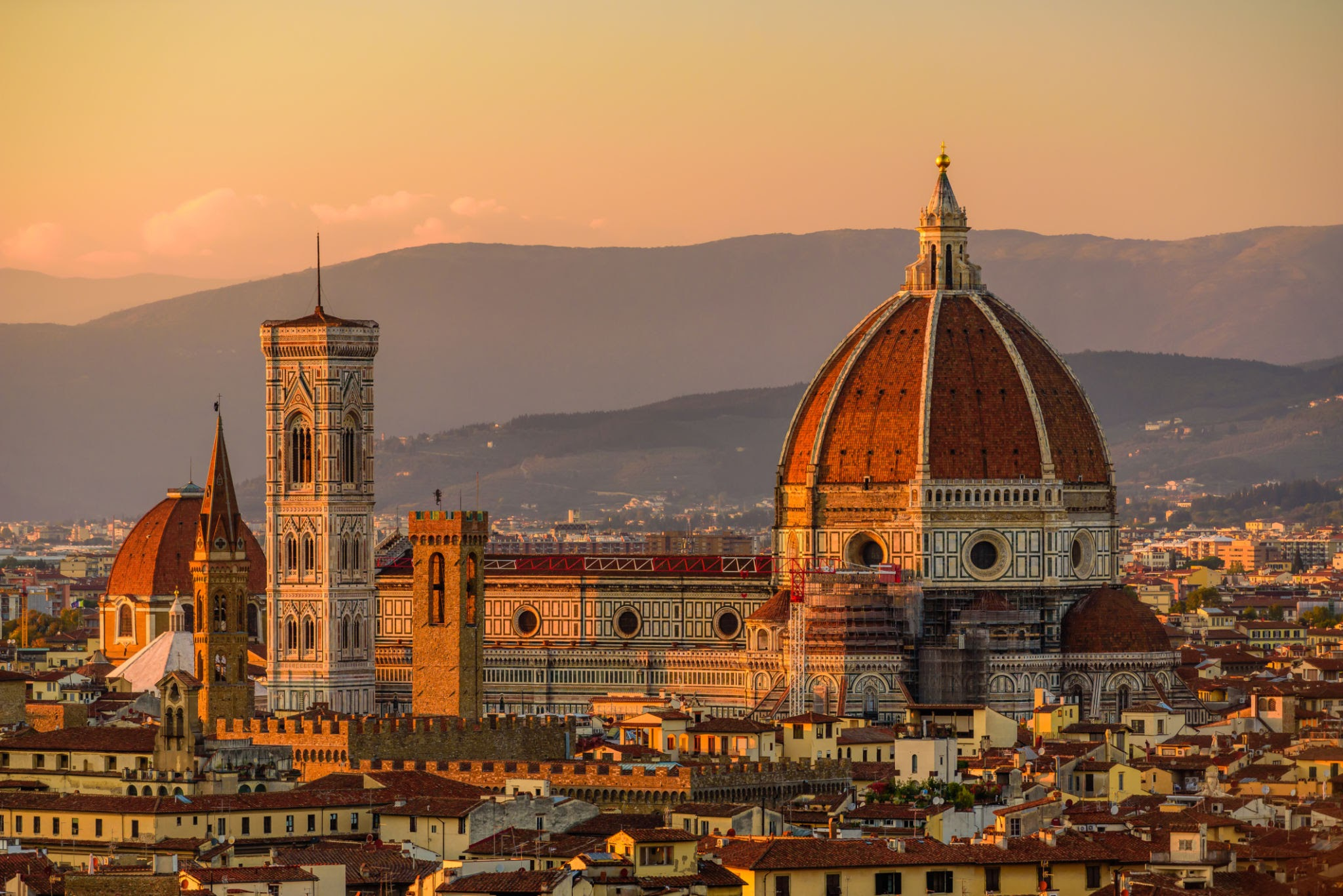
The Florence Cathedral, formally known to the world as Santa Maria del Fiore, is not simply a religious building; it is a profound, stone-and-marble statement of civic pride, unimaginable wealth, and the dawning of the Renaissance. For cultural travelers and history enthusiasts, standing before its polychrome marble facade is an essential rite of passage. To understand the Florence Duomo is to understand the very heart of the Renaissance—a period when human ingenuity dared to challenge the heavens.
Table of Contents
The Architectural Evolution: From Ancient Foundations to Neo-Gothic Splendor
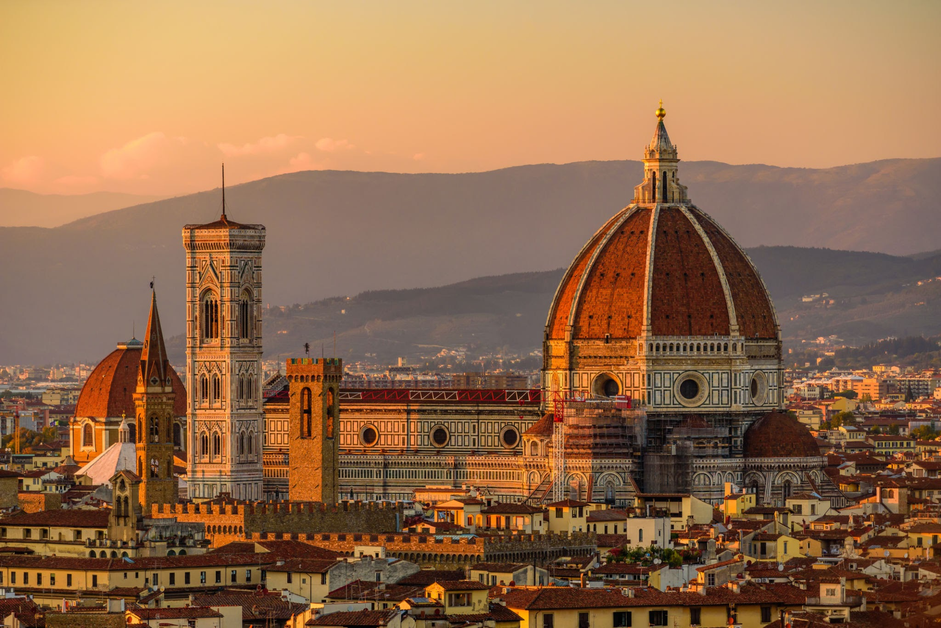
The story of the Florence Cathedral begins in the late 13th century. By 1296, the city of Florence had grown into a European economic powerhouse, heavily enriched by its booming wool and banking trades. Its existing church, Santa Reparata, was crumbling and embarrassingly small compared to the grand new cathedrals being erected by political rivals in Pisa and Siena. Florence needed a structure that would visually dominate the Tuscan landscape.
Arnolfo di Cambio’s Latin Cross Plan
The monumental task was handed to master builder Arnolfo di Cambio, who laid out a breathtakingly ambitious Latin cross plan. His vision featured a vast, wide nave terminating in a massive octagonal choir. The sheer scale of the intended structure was unprecedented. The dimensions of the nave alone were designed to hold 30,000 worshippers—essentially the entire population of Florence at the time.
However, di Cambio died in 1302, and construction slowed to a crawl, further hindered by the devastating Black Death in 1348. Over the next century, subsequent architects, including the famed Giotto, continued the work, expanding di Cambio’s original plans and pushing the boundaries of medieval engineering to their absolute breaking point.
The Contrast of the Interior and the De Fabris Facade
When you step inside Santa Maria del Fiore, you might be surprised by the stark, unadorned austerity of the interior. Unlike the heavily gilded cathedrals of Rome or Venice, the Florence Cathedral reflects the stern, spiritual ideals of early Florentine religion. The immense, echoing nave forces your eyes forward and upward toward the altar and the awe-inspiring dome.
Conversely, the exterior of the cathedral is an explosion of color. The stunning exterior we see today—a meticulously patterned tapestry of white marble from Carrara, green marble from Prato, and pink marble from Siena—was not actually completed during the Renaissance. The original facade was dismantled in the 16th century, and the cathedral sat bare-faced until the 1880s. The current neo-Gothic De Fabris facade, designed by Emilio De Fabris, was finally unveiled in 1887, serving as a brilliant, harmonious homage to the original Renaissance styling.
The Dome’s Genius: Filippo Brunelleschi’s Masterpiece
By 1418, the cathedral was nearly complete, save for the massive, 42-meter-wide octagonal hole over the high altar. The original architects had rejected the use of Gothic flying buttresses, leaving no obvious way to support a traditional dome of that size. The city held a public competition to solve the impossible architectural puzzle.
Enter Filippo Brunelleschi, a notoriously hot-tempered goldsmith and clockmaker with no formal architectural training. His solution would change the course of Italian Renaissance architecture forever.
A Double-Shell Masonry Dome
Brunelleschi’s genius lay in his proposition of a double-shell masonry dome. Instead of a single, impossibly heavy solid roof, he built two lighter domes: a thicker inner dome to serve as the structural backbone, and a thinner outer shell to protect the building from the weather and provide the soaring, majestic profile that dominates the Florentine skyline today.
To overcome the catastrophic outward thrust that threatened to collapse the structure, he embedded hidden horizontal chains of stone and iron throughout the dome’s base, effectively squeezing the structure like hoops on a wooden barrel.
The Herringbone Brickwork
Perhaps the most celebrated aspect of this Renaissance engineering miracle is the way it was constructed without traditional wooden centering (scaffolding). Brunelleschi utilized a revolutionary herringbone brickwork pattern. By laying the bricks in an interlocking, spiraling diagonal sequence, the dome essentially supported its own weight as it rose curve by curve into the sky. He even had to invent a massive ox-driven hoist to lift the millions of bricks and heavy sandstone blocks hundreds of feet into the air.
Vasari’s Last Judgment
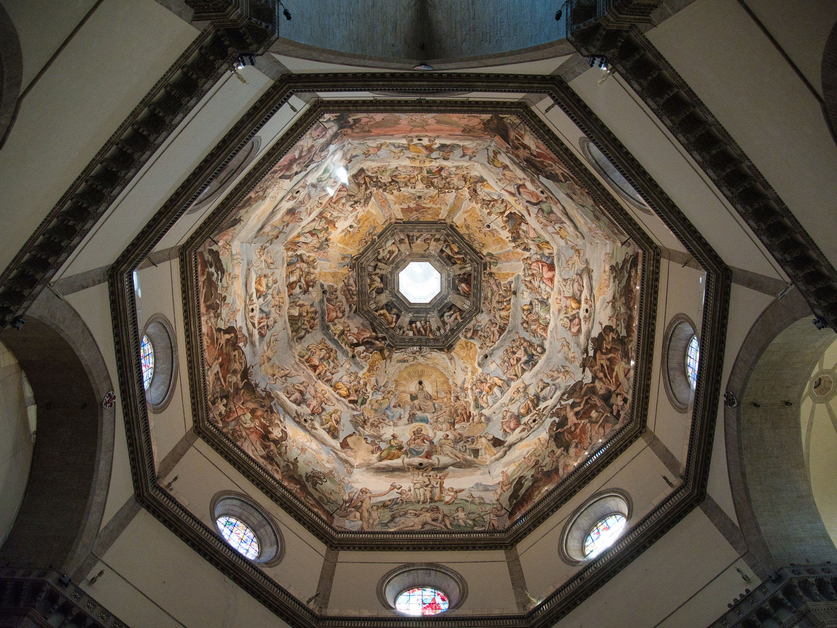
While Brunelleschi engineered the structure, the interior of the dome was left blank for over a century. It was finally painted between 1572 and 1579 by Giorgio Vasari and his successor, Federico Zuccari. Covering 3,600 square meters, Vasari’s Last Judgment is an immersive, vividly terrifying, and brilliantly colored fresco. As you undertake the dome climb, you are brought face-to-face with the swirling masses of angels, saints, and the damned, offering a visceral artistic experience that perfectly complements the engineering triumph beneath it.
Visitor’s Guide: How to Experience the Monumental Complex
Navigating the logistics of the Florence Cathedral can be as complex as its history. The site is divided into free access areas and a paid monumental complex. Understanding the difference is crucial to planning a successful visit.
Free Access vs. The Paid Complex
Entrance to the main nave of Santa Maria del Fiore is completely free. However, because it is free, the security lines wrap around the piazza and can require hours of waiting in the sun.
If you want to experience the deeper history, you will need to purchase Florence Cathedral tickets to access the surrounding monumental complex. This paid complex includes the Baptistery of San Giovanni, Giotto’s Campanile (the bell tower), the ancient crypt of Santa Reparata beneath the cathedral floor, and the stellar Museo dell’Opera del Duomo, which houses the original Ghiberti bronze doors and Donatello’s sculptures.
Securing the Brunelleschi Pass for the Dome Climb
The ultimate experience for any visitor is ascending to the top of the cupola. To do this, you must purchase the specific Brunelleschi Pass. This premium ticket grants you access to all monuments in the complex, but most importantly, it secures your timed-entry reservation for the dome climb.
Be warned: climbing the dome is a strenuous, claustrophobic journey up 463 narrow, spiraling stone steps. There is no elevator. However, the reward at the top—an unparalleled, 360-degree panoramic view of Florence—is worth every drop of sweat. The Brunelleschi Pass often sells out weeks in advance, so booking early on the official Opera di Santa Maria del Fiore website is mandatory.
The Strict Dress Code and Sunday Closures
The Florence Cathedral remains an active, sacred place of worship. As such, a strict dress code is rigidly enforced by guards at every entrance. Shoulders and knees must be fully covered for both men and women. Tank tops, short shorts, and miniskirts will result in immediate denial of entry, regardless of whether you have a pre-purchased ticket. If you are traveling in the hot Tuscan summer, pack a lightweight scarf in your day bag to drape over your shoulders.
Additionally, travelers must note that the main cathedral floor is completely closed to tourists on Sundays and major Catholic holidays to accommodate religious services. While you may still be able to use your Brunelleschi Pass to climb the dome or the bell tower on a Sunday, you will not be able to tour the free interior nave.
Frequently Asked Questions (FAQs)
How much does it cost to enter the Florence Cathedral?
Entrance to the main nave of the Florence Cathedral is entirely free of charge. However, accessing the dome, the bell tower, the crypt, the baptistery, and the museum requires purchasing specific Florence Cathedral tickets, which range in price depending on the pass you select.
Is the Brunelleschi Pass worth the price?
Yes, absolutely. The Brunelleschi Pass is the only ticket that allows you to undertake the dome climb. Aside from the incredible panoramic views of the city, the climb allows you to walk between Brunelleschi’s double-shell architecture and see Vasari’s Last Judgment fresco up close.
How many steps are in the Florence dome climb?
The journey to the top of Brunelleschi’s dome consists of exactly 463 steps. The stairways are narrow, steep, and original to the Renaissance construction, meaning there are no elevators or modern modifications for accessibility.
Can I buy Florence Cathedral tickets on the same day?
While it is occasionally possible to buy basic passes for the museum or bell tower on the same day during the low season, the Brunelleschi Pass almost always sells out days, if not weeks, in advance. It is highly recommended to book online ahead of your trip.
Why is the cathedral facade a different style than the interior?
The interior was built during the late Middle Ages and early Renaissance, reflecting a more austere religious focus. The exterior facade remained unfinished brick for centuries until the neo-Gothic De Fabris facade was completed in 1887 to celebrate Italy’s unification, resulting in the brilliant polychrome marble exterior we see today.
Conclusion
The Florence Cathedral is much more than a beautiful backdrop for vacation photos; it is a masterclass in human ambition. From Arnolfo di Cambio‘s unimaginably grand floor plan to the mathematical wizardry of Brunelleschi’s dome, Santa Maria del Fiore stands as a testament to what a society can achieve when art, science, and civic pride collide. Whether you are staring up at the neo-Gothic De Fabris facade from the piazza, shivering in the ancient crypt, or panting at the top of the 463-step dome climb, the Duomo promises an unforgettable encounter with history. Secure your Brunelleschi Pass early, respect the sacred space, and prepare to step into the very soul of the Italian Renaissance.